


Our tree planting project is one of the largest and most successful tree planting projects in Malawi, providing a long-term solution to fighting deforestation in Africa caused by the destruction of indigenous forest.


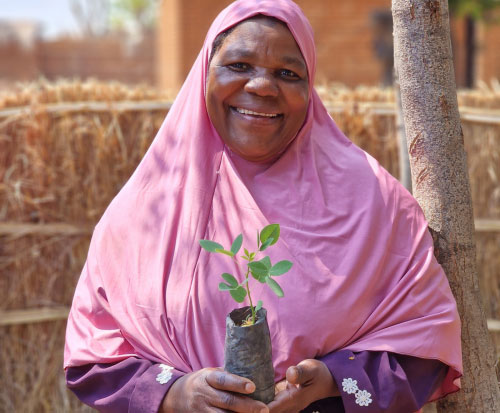
WE WORK WITH FARMERS AND COMMUNITY CLUBS IN THREE DISTRICTS

TREE SPECIES INCLUDE SENNA SIAMEA, MTANGATANGA, AND MBAWA

WE ALSO PLANT PINE TREES FOR A SUSTAINABLE SOURCE OF TIMBER



We have helped communities plant over 30 million trees. Our aim is to continue supporting the communities to plant trees that provide a sustainable source of firewood and timber, and educate them on the benefits of investing in tree planting for the future. We will combine household tree planting with the provision of our Changu Changu Moto fuel-efficient cookstoves.
We identify farmers and community groups who are able to grow seedlings and can care for the trees. We then provide them with relevant equipment and training. We work in partnership with communities and government departments, and educate the local communities on the benefits of conservation.
Our tree planting project is split into two. One part is a fully funded pine tree carbon project, and the other project supports tree farmers to grow sustainable sources of timber and firewood.
This project takes place in Nkhotakota and Salima Districts where farmers plant a variety of tree species so that in the future they have a sustainable source of firewood and timber. In Mzimba District farmers are planting trees for a sustainable source of timber. These projects are not a verified carbon offsetting project.
Despite many people asking us how much carbon would they be offsetting by planting trees with us, it would be misleading to claim that planting trees with us is a way of offsetting your carbon emissions. This is due to the mixture of trees that have different end purposes, for example, if the wood is used as firewood.
However, if you require verified carbon offsets, we can provide these through our audited and verified fuel-efficient cookstove project. Contact us for more information.
Lorem ipsum dolor sit amet, consectetur adipiscing elit. Ut elit tellus, luctus nec ullamcorper mattis, pulvinar dapibus leo.
Tree Planting
Ripple Africa’s tree planting project is one of the largest and most successful tree planting projects in Malawi. We provide a long-term solution to fighting deforestation in Africa caused by the destruction of indigenous forests.
The tree planting project directly fights this by planting thousands of quick-growing trees with farmers, schools and community groups, and these provide a sustainable source of firewood and timber for local people.
High population growth has been the prime cause of deforestation across Malawi and has led to soil degradation, landslides, perennial rivers drying up, rain shortages and depletion of wildlife. Wood is taken from indigenous forests for building and to use for cooking. Increasing numbers of people have become involved in the production and sale of charcoal, particularly in areas near towns, further decimating the remaining forests. Trees are also cut down for firewood and timber used for housebuilding or are burned to make space for growing crops.
Ripple Africa’s tree planting project is not only about planting trees in Malawi, but also about changing the way people think about their natural environment and the destructive and unsustainable actions which are causing deforestation. By involving farmers, community groups and schools, Ripple Africa aims not only to encourage more tree planting in Africa, but to slowly change how people value and use all their natural resources.
Ripple Africa first started to address this issue in the area around its base in Nkhata Bay District, providing local communities with quick-growing trees which provide an immediate benefit to the community. The trees can be used like a crop by coppicing them (cutting off the branches for firewood without felling the whole tree), and then they grow back quickly to provide more wood year on year.
However, we started working in the north of Mzimba District in 2015 where deforestation is much more severe. Since then, the project has expanded to cover all of Mzimba. Here we are working with farmers who are prepared to invest a considerable amount of time (it takes up to 20 years to grow a tree large enough to sell for timber) to ensure that larger numbers of trees can be grown successfully. A large majority of farmers in this District are part of a carbon offsetting project.
The tree planting project expanded again in 2023 when we started planting trees with farmers in Nkhotakota and Salima Districts in Malawi. We are working with farmers and community groups to grow around 500,000 seedlings per District. These seedlings include senna siamea, blue gum, mbawa, mtangatanga, mthewe and nsangu amongst others, and once they are growing, they will provide people with a sustainable source of firewood and in the longer-term, timber.
The vast majority of forests in both of these Districts have been completely wiped out not only to make way for houses and farmland, but also the hills have been destroyed by the charcoal industry.
Since the project began in 2004, we have helped communities plant 30 million trees in Nkhata Bay, Nkhotakota, Salima and Mzimba Districts in Malawi, Africa.
Ripple Africa’s environmental staff work in partnership with District Forestry staff to identify farmers and community groups who are able to grow seedlings and can care for the trees as they grow to maturity. Local climate (rainfall, temperature, etc.) is taken into consideration when deciding on the species of trees to plant in each area.
We provide the farmers and groups with enough seeds for the area where they are going to plant them out (there is no point planting trees too close together as they will not thrive) and spend time teaching them how to plant and care for them effectively to ensure that they get the maximum number to germinate and grow. The farmers and groups are provided with plastic tubes in which to plant the seeds and with watering cans and other equipment that they will need. We visit the tree nurseries regularly to build up a relationship with the growers, teach them how to care for the trees, monitor the success of each tree nursery and help troubleshoot when problems occur.
Then we work with the farmers and groups to teach them how best to prepare the land where the trees will be planted out and how to ensure that they grow most effectively once they are in their permanent location. Regular visits ensure that we are able to help maximise the yield from the trees, and we monitor the numbers of trees that are successfully planted out.
Although giving the seeds and the equipment to farmers could be seen to be at odds with our ‘providing a hand up not a hand out’ ethos, the farmers themselves have to invest many years of effort to ensure that the trees thrive before they are able to make an income through selling the wood. The provision of the seeds is only the starting point.
We intend to increase the numbers of trees grown in Malawi by working with more and more farmers who are able to grow much larger numbers of trees.
Malawi is facing a potentially catastrophic shortage of wood, and the cost of wood for building and firewood is rising to reflect the shortage of wood in the country. By helping farmers grow fast-growing pine and eucalyptus which are in high demand for building – and other fast-growing species used for firewood – we are hoping to reduce the pressure on indigenous forests.
We are linking our Tree Planting project with our Forest Conservation and Changu Changu Moto (fuel-efficient cookstove) projects to reinforce the importance of conservation and encourage communities to make more effective use of their remaining natural resources.
With these ongoing projects, we are doing our best to reduce deforestation in Malawi.

IN NKHOTAKOTA AND SALIMA DISTRICTS A VARIETY OF TREE SPECIES ARE GROWN

IN MZIMBA DISTRICTS FARMERS RAISE AND PLANT PINE TREE SEEDLINGS

FARMING FAMILIES CARE FOR THEIR TREES AS THEY GROW




We use cookies to improve your experience on our site. By using our site, you consent to cookies.
Websites store cookies to enhance functionality and personalise your experience. You can manage your preferences, but blocking some cookies may impact site performance and services.
Essential cookies enable basic functions and are necessary for the proper function of the website.
These cookies are needed for adding comments on this website.
Google Tag Manager simplifies the management of marketing tags on your website without code changes.
Stripe is a payment processing platform that enables businesses to accept online payments securely and efficiently.
Service URL: stripe.com (opens in a new window)