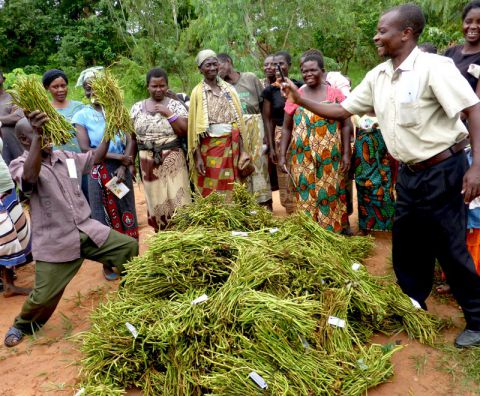
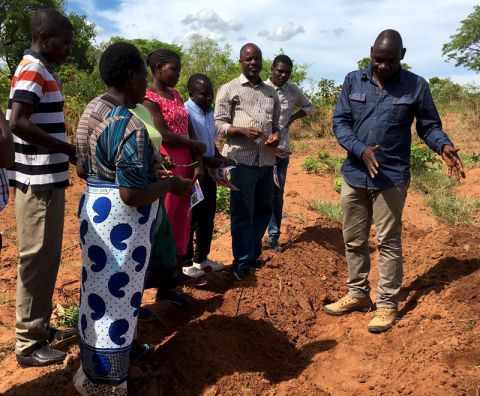
FARMERS ARE EXCITED ABOUT RECEIVING THE VINES
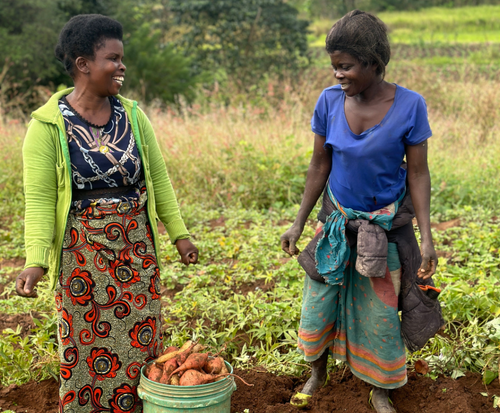
THE SWEET POTATO ARE MUCH MORE NUTRITIOUS AND LOVELY TO EAT
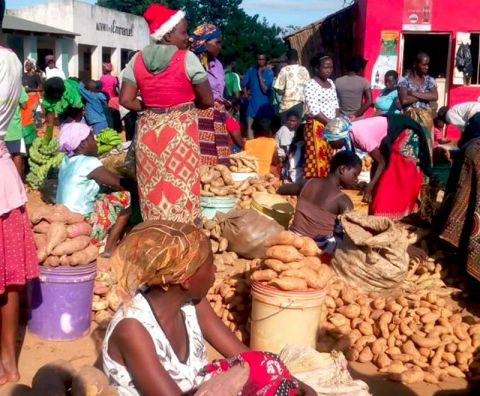
SURPLUS SWEET POTATOES CAN BE SOLD AT LOCAL MARKETS
We are introducing new varieties of sweet potatoes into Nkhata Bay District. These new varieties are being grown in all our pre-schools and by many farmers in Nkhata Bay District. We hope to secure additional supplies of the improved sweet potato vines and tubers to expand the reach of the programme.
Sweet potato vines can be planted in two different ways – to either multiply the sweet potato vines or to produce a higher yield of the crop. The farmers start with 100 tubers each and are encouraged to plant some which will produce additional vines and then, when they harvest, they have enough stems to be able to share some with other local families. This benefits more people and is a truly sustainable way to encourage communities to help each other.
Lorem ipsum dolor sit amet, consectetur adipiscing elit. Ut elit tellus, luctus nec ullamcorper mattis, pulvinar dapibus leo.
Malnutrition is a major problem in Malawi as the staple diet is nsima, a porridge made from cassava or maize flour, with little protein and very few vitamins. Although sweet potato farming in Africa is not uncommon and some white-fleshed sweet potatoes are grown in our area, the higher yielding orange-fleshed sweet potatoes which are higher in Vitamin A and other nutrients, are not grown in the north of Malawi.
Sweet potatoes are not an indigenous plant in Malawi. The variety we are helping communities to grow is an improve orange variety developed by CIP (International Potato Centre) who have a research and sweet potato farm in Mulanje, southern Malawi. The orange-fleshed sweet potato is not genetically modified but has been developed through conventional breeding techniques to produce a variety higher in Vitamin A and higher yielding than the varieties of sweet potatoes usually grown in Malawi. You can find out more here.
However, farmers and smallholders cannot afford to purchase the vines needed to plant these improved varieties.
Ripple Africa wants to support more farmers to grow new varieties of orange-fleshed sweet potatoes to improve local people’s diets. Farmers pass on vines to their neighbours increasing production at no extra cost. We are also educating householders on how to cook and use sweet potatoes in family meals to improve their nutritional value. In addition, Ripple Africa pre-school teachers provide a sweet potato meal for every child attending their pre-schools.
The project builds on a pilot project which has already proved very successful. Ripple Africa were approached by CIP (The International Potato Center) who were funded to scale up the introduction of orange-fleshed sweet potatoes into Malawi, which are higher yielding and contain higher levels of Vitamin A. CIP were looking for an NGO based in the north of Malawi to manage the distribution of the new sweet potato tubers to farmers in the area who would then report on their success at growing these and highlight any issues.
Ripple Africa is being supplied with sweet potato tubers from a supplier called Nankhwali Farm. Nankhwali focuses on five orange-fleshed sweet potato (OFSP) varieties: Chipika, Kadyaubwerere, Kaphulira, Mathuthu, and Ana Akwanire.
Ripple Africa worked in partnership with the District Agriculture team to carry out a large scale distribution operation, giving bundles of vines to hundreds of farmers within five geographical areas of Nkhata Bay District. In each bundle, there were 100 x 30cm tubers. The District Agriculture team are keen to expand this which is why it is working so well.
To date we have supported over 7,523 farmers to grow the improved varieties, and work with multiplication farmers to produce around one million quality vines each year for the next growing season.
These new varieties are also being grown by our pre-school teachers and by many farmers in Nkhata Bay District.

Our sweet potato farming project in Africa is simple. The farmers start with 100 tubers each but, when they harvest, they have enough stems to keep some for their family and to share the rest with other local families to multiply the number of people benefiting.
District Agriculture and Ripple Africa environmental staff monitor how well the potatoes grow, measure yields and assist farmers with the ongoing distribution of their surplus tubers.
We will continue to purchase the initial stock of clean orange-fleshed sweet potato vines from Vumbwe research centre in the south of Malawi and select and train 10 commercial multiplication farmers who will multiply the vines ready for distribution to other farmers making the project sustainable.
We will continue working in partnership with District Agriculture Department teams to support the farmers and to help them maximise their yields.
We have seen improved yields from these sweet potatoes and anticipate that this success will continue. Thousands of households are growing and eating the more nutritious varieties of sweet potatoes, significantly improving their diet.
FAMILIES ARE ABLE TO COOK BREAKFAST FOR THEIR CHILDREN BEFORE SCHOOL
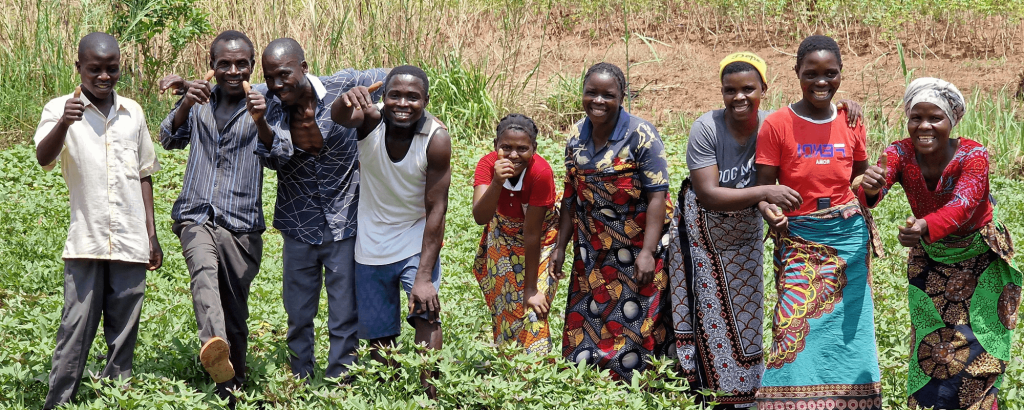
ON-SITE TRAINING IS GIVEN TO FARMERS SO THEY CAN ACHIEVE GOOD YIELDS
EACH YEAR MULTIPLICATION FARMERS PRODUCE QUALITY VINES FOR DISTRIBUTION
We use cookies to improve your experience on our site. By using our site, you consent to cookies.
Websites store cookies to enhance functionality and personalise your experience. You can manage your preferences, but blocking some cookies may impact site performance and services.
Essential cookies enable basic functions and are necessary for the proper function of the website.
These cookies are needed for adding comments on this website.
Google Tag Manager simplifies the management of marketing tags on your website without code changes.
Stripe is a payment processing platform that enables businesses to accept online payments securely and efficiently.
Service URL: stripe.com (opens in a new window)